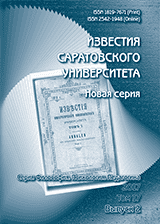
Izvestiya of Saratov University.
ISSN 1819-7671 (Print)
ISSN 2542-1948 (Online)


Философия

Being-meaning in the Deconstructive Ontology of Jacques Derrida

The article deals with the problem of the ontological content of the deconstructive hermeneutics proposed by Jacques Derrida. It is demonstrated that being, recognized as the event in the late Heideggerian ontology, in the ontological perspective of deconstruction yields its place to the post-eventual being-meaning, combining the singularity with its own absence, where being could not be conceived outside the context of the possibilities of its interpretation. The task of deconstructive ontology is not at all to invent concepts, as G.

Philosophical Heritage of Karl Marx as Basis for Judgment of a Phenomenon of Science

The article is devoted to the study, in the context of the tradition of the philosophy of science, of problems of rationality that are characteristic of the scientific research of Karl Marx. The philosophy of science is understood as a historical process and the historical result of the systematic application of the whole semantic potential of philosophy to the comprehension of the phenomenon of science, the history of science.

Mental Illness as Consequence of Social Transformations: Philosophical Interpretation of Medical-anthropological Researches

The aim of the article is the philosophical comprehension of some results of medico-anthropological research devoted to the problems of mental disorders in the context of social transformations. Following the tradition laid down by the philosophical work of Michel Foucault on the history of madness in modernity, the author proposes to continue the practice of comprehension of the most significant «fragments of insanity» in our modern world. This approach involves maintaining a dialogue with other forms of thought, including a discipline such as medical anthropology.

Philosophical Approach to the Study of a Museum Exhibit

The article are examined issues phenomenology of the museum. The phenomenology of the museum is methodological approach in the philosophical analysis. Main subject of research is a museum exhibit for the study of which socio-philosophical approach is involved. In the article it is noted that the thing-exhibit is a necessary component of the cultural space of the museum. The author notes, that the thing of the institution of culture acquires an ontological status and own history.

About Features of S. Н. Bulgakov's Philosophical Outlook

The article is devoted to the consideration of the features of the philosophical worldview of S. N. Bulgakov – a representative of Russian religious philosophy of the turn of the XIX – early XX centuries in the context of the cultural and historical and socio-political realities of the time and the established traditions, trends characteristic of Russian philosophy. On the whole, the understanding of the philosopher’s philosophical creativity is not possible without knowing the main coordinates of his worldview.

Sophia in the Bible and in Russian Sophiology: Aspect of Wife

The article explores the unique, but scantily investigated in Russian sophiology, concept of Sophia the Wisdom of God as “a Wife clothed with the sun”. According to the Bible, the first Sophia’s witness was The God Himself and his Prophets, on which all Russian sophiologists accentuated their attention. Religious mystical experience of sophiologists is the important determinant for acknowledgement of Sophia image.

The Image of War: the Problem of Content and Formation

War as a complex social phenomenon can be analyzed from different perspectives: it appears as a socio-political phenomenon, as a civilizational, as an existential one. Importantly on war-man, so war is perceived not only on level facts, but and in the form of way of, which represents complex views about it, including and assessment of events, and assessment of enemy, and own image. In the structure of the image of the war, the author highlights the foretypes, synchro and prototyping.

Память как социальный феномен

Социальная память - это совокупность знаний, которые служат предметом фиксированной передачи от одного поколения к другому. Она закреплена в базовых текстах культуры, изучение которых - обязательное условие социализации индивида в определенное культурное сообщество. Носителями социальной памяти являются социальные общности, поскольку процессы коммуникации между представителями этих общностей являются постоянным индикатором актуальности циркулирующей в обществе информации.

Problem Body-being in Russian Philosophical Tradition

According to Russian religious philosophy the Human is the unique essence arising on crossing of two worlds – natural and spiritual. He is initially spiritual-body-being; the Human is included in the order of the nature and the point of this including is sex; the Human is transformation, updating of the sex; the Human is a loving being. The love is a manifestation of individuality, the statement of the eternal, the immortal in the person.

The Critics of Metaphysics and Logocentrism as the Foundations of Interpretative Strategies of Deconstruction

The article is dedicated to analysis of the notion of logocentrism which is used for deconstruction of metaphysics. Nonclassic conception of sign, formed in philosophy of J. Derrida, is researching. This puts methodological foundation for interpretative strategies which can be used for any kind of texts: philosophical, literary and sociocultural.

Pages